We know that in at least one state and possibly all of the key states, Republican voter suppression laws turned the 2016 Presidential election.
How much funding did the NRA put into these efforts? And how much of that came from Russia?
Showing posts with label Republican. Show all posts
Showing posts with label Republican. Show all posts
Thursday, July 19, 2018

Thursday, March 9, 2017

Wednesday, February 8, 2017
Republican Senators Terrified of 1986 Letter
The letter that Republican Senators of the 115th Congress couldn't stand to hear read by Senator Warren follows. It happens to be a letter that Republicans of 30 years ago could stomach and found compelling. But in 2017, they can't stand to hear it.


Monday, November 28, 2016
Broad Stroke Story of The Election: National Versus State

In broad strokes, the national-level story of the United States 2016 Presidential election could be described as that the rough trend continued.
| D/VAP | R/VAP | Avg/VAP | |
| 1996 | 0.2409 | 0.1992 | 0.2200 |
| 2000 | 0.2431 | 0.2405 | 0.2418 |
| 2004 | 0.2689 | 0.2826 | 0.2757 |
| 2008 | 0.3022 | 0.2607 | 0.2815 |
| 2012 | 0.2802 | 0.2590 | 0.2696 |
| 2016 | 0.2575 | 0.2487 | 0.2531 |
There was a swing up between the mid 90s and the mid 00s. The Democratic and Republican percentages of the voting age population (VAP) both increased in 2000 and 2004, with a much bigger Republican increase in 2000.
Then there was a transition in 2008. That year, the Democrats had a much bigger increase equivalent to the Republican jump of 2000. Meanwhile, the Republican turnout began sliding down.
And now we're in a swing down in the 10s. The Democratic and Republican percentages of the voting age population both decreased in 2012 and 2016.
Where will we go from here? For both parties, the percentage of the VAP in 2016 was still up from what either party saw in 1996 and 2000. Considering the past two decades on average, we can't really say there was low turnout in 2016; just not quite as high as the peaks. Both candidates this year got a higher percentage of the potential vote -- more support -- than even the winning candidates from 16 and 20 years ago. We'd have to go back to 1984 to find a higher percentage of the VAP turning up for the two major parties; and that was the only higher year between 1980 and 2000. Based on the trend of the last 10 elections, we're likely only approaching the valley and barring some particular phenomenon drawing more people out to vote we'll likely see yet another decline in overall turnout next Presidential election.

If there's one thing we can say from the overall national trend, it's that the narrative of unenthused voters doesn't really fit. We've heard claims that voters were particularly disinterested in these candidates. Yet what drop there was this year was only in keeping with the direction of the past few elections. The turnout / VAP in 2016 remained over the average for the last 10 elections.
There also quite clearly was no national surge whatsoever toward the Republican party. On the contrary, the Republican specific turnout was yet again down slightly, just like in the previous election. In fact, this year's Republican turnout brought it low enough at 24.87% to be below the 25.47% average Republican turnout for the last 10 elections.
Democratic turnout also was only down this year by about the same degree it was down the previous Presidential election. And that was only returning it towards the rough trend, smoothing out from previous big gains. The 2016 Democratic turnout of 25.75% remained slightly above the 24.92% they've seen for the last 10 elections.
By and large, the nation continued a return towards trend. The Republican party dipped slightly below their average; and the Democratic party remaining slightly above. There may have been changes in the character of each party's support, such as the widely reported gains among the less educated for Republicans and among the more educated for Democrats. But these qualitative fluctuations did not budge the totals from the previous quantitative heading nationally.
If there's a major story specific to this 2016 Presidential election that differs from the typical trend of the previous years, it would have to be at the state-by-state level. It isn't just that a few states decided the election in the electoral college; it's also that what happened in those particular states and the states that went the other way from them would together have to be the entire story of how this election might differ from the norm in voting.
* Popular vote totals used for the above analysis were derived from Dave Leip's Atlas of U.S. Presidential Elections as of 11/28/2016.
Broad Stroke Story of The Election: National Versus State
In broad strokes, the national-level story of the United States 2016 Presidential election could be described as that the rough trend continued.
| D/VAP | R/VAP | Avg/VAP | |
| 1996 | 0.2409 | 0.1992 | 0.2200 |
| 2000 | 0.2431 | 0.2405 | 0.2418 |
| 2004 | 0.2689 | 0.2826 | 0.2757 |
| 2008 | 0.3022 | 0.2607 | 0.2815 |
| 2012 | 0.2802 | 0.2590 | 0.2696 |
| 2016 | 0.2575 | 0.2487 | 0.2531 |
There was a swing up between the mid 90s and the mid 00s. The Democratic and Republican percentages of the voting age population (VAP) both increased in 2000 and 2004, with a much bigger Republican increase in 2000.
Then there was a transition in 2008. That year, the Democrats had a much bigger increase equivalent to the Republican jump of 2000. Meanwhile, the Republican turnout began sliding down.
And now we're in a swing down in the 10s. The Democratic and Republican percentages of the voting age population both decreased in 2012 and 2016.
Where will we go from here? For both parties, the percentage of the VAP in 2016 was still up from what either party saw in 1996 and 2000. Considering the past two decades on average, we can't really say there was low turnout in 2016; just not quite as high as the peaks. Both candidates this year got a higher percentage of the potential vote -- more support -- than even the winning candidates from 16 and 20 years ago. We'd have to go back to 1984 to find a higher percentage of the VAP turning up for the two major parties; and that was the only higher year between 1980 and 2000. Based on the trend of the last 10 elections, we're likely approaching the valley if not having bottomed out for the current downswing.
If there's one thing we can say from the overall national trend, it's that the narrative of unenthused voters doesn't really fit. We've heard claims that voters were particularly disinterested in these candidates. Yet what drop there was this year was only in keeping with the direction of the past few elections. The turnout / VAP in 2016 remained over the average for the last 10 elections.
There also quite clearly was no national surge whatsoever toward the Republican party. On the contrary, the Republican specific turnout was yet again down slightly, just like in the previous election. In fact, this year's Republican turnout brought it low enough at 24.87% to be below the 25.47% average Republican turnout for the last 10 elections.
Democratic turnout also was only down this year by about the same degree it was down the previous Presidential election. And that was only returning it towards the rough trend, smoothing out from previous big gains. The 2016 Democratic turnout of 25.75% remained slightly above the 24.92% they've seen for the last 10 elections.
By and large, the nation continued a return towards trend with the Republican party dipping slightly below their average and the Democratic party remaining slightly above. There may have been changes in the character of each party's support, such as the widely reported gains among the less educated for Republicans and among the more educated for Democrats. But these qualitative fluctuations did not budge the totals from the previous quantitative heading nationally.
If there's a major story specific to this 2016 Presidential election that differs from the typical trend of the previous years, it would have to be at the state-by-state level. It isn't just that a few states decided the election in the electoral college; it's also that what happened in those particular states and the states that went the other way from them would together have to be the entire story of how this election might differ from the norm in voting.
* Popular vote totals used for the above analysis were derived from Dave Leip's Atlas of U.S. Presidential Elections as of 11/28/2016.
Tuesday, November 8, 2016
November Elections
In November of 1932, eighty-four years and two days before the 2016 American election, the majority of the German people did not do anything quite like the way hindsight and simplification might make it look. Combined, just slightly more of the German electorate voted for the next two parties than voted for the Nazis. In total, a hair over twice as many people voted for the total of all other parties than voted for the NSDAP (that is, the Nazis). However, this doesn't make it just a matter of what the mere 1/3 who voted for Hitler's party chose.
By and large, what the German people did was fail to unite against the Nazis.
But their grave error wasn't one of failing to vote for a party and its leader who we all now know would commit all the horrors of the Holocaust. Their disgrace came not from the things they didn't know then but from failing to recognize all the relatively little bad that was quite clear at the time. Back then, nobody knew it would mean the atrocity of slaughtering millions and a permanent national disgrace to fail to unite behind the most viable alternative.
They knew the Nazi leader winked at the violence of his party and maybe even encouraged it.
They knew he attacked his nation's negotiated treaties.
They knew his party embraced an ideology favoring one particular race and xenophobic of others.
They knew he used anti-Semitism in his campaign.
They knew his party opposed women being in the workplace, pushing that they stay home producing children.
They knew he'd botched his preferred line of work and essentially gone bankrupt.
They knew about his failed coup.
They saw all his various campaign attacks on people and groups.
They had a pretty good idea he was more than a bit unhinged.
And sure, it was only the worst 1/3 of them that embraced him despite all of that.
But the majority of the German people knew all of this and failed to consider it sufficiently crucial for them to unite to keep Hitler and his party out of power. They considered it more important that they not vote for a party other than their particular preference. Or that they punish a party they usually preferred but that hadn't made everything better fast enough.
They saw a lot of warning signs. And they failed to stop it. And that's more than bad enough.
It would have been more than bad enough even if the Hitler of 1932 hadn't eventually become the Hitler of the later 1930s through the mid 1940s. The Hitler of 1932 was not then the Hitler of later history. But what was known in 1932 should have been plenty to unite to stop the Nazis from ever attaining power.
By and large, what the German people did was fail to unite against the Nazis.
But their grave error wasn't one of failing to vote for a party and its leader who we all now know would commit all the horrors of the Holocaust. Their disgrace came not from the things they didn't know then but from failing to recognize all the relatively little bad that was quite clear at the time. Back then, nobody knew it would mean the atrocity of slaughtering millions and a permanent national disgrace to fail to unite behind the most viable alternative.
They knew the Nazi leader winked at the violence of his party and maybe even encouraged it.
They knew he attacked his nation's negotiated treaties.
They knew his party embraced an ideology favoring one particular race and xenophobic of others.
They knew he used anti-Semitism in his campaign.
They knew his party opposed women being in the workplace, pushing that they stay home producing children.
They knew he'd botched his preferred line of work and essentially gone bankrupt.
They knew about his failed coup.
They saw all his various campaign attacks on people and groups.
They had a pretty good idea he was more than a bit unhinged.
 |
| Trump's RCP Average Favorability as of 11/8/2016: 37.5% |
But the majority of the German people knew all of this and failed to consider it sufficiently crucial for them to unite to keep Hitler and his party out of power. They considered it more important that they not vote for a party other than their particular preference. Or that they punish a party they usually preferred but that hadn't made everything better fast enough.
They saw a lot of warning signs. And they failed to stop it. And that's more than bad enough.
It would have been more than bad enough even if the Hitler of 1932 hadn't eventually become the Hitler of the later 1930s through the mid 1940s. The Hitler of 1932 was not then the Hitler of later history. But what was known in 1932 should have been plenty to unite to stop the Nazis from ever attaining power.
Thursday, October 17, 2013
Shutdown: Since When Does Losing Give One A Mandate?
In a republic such as ours, while the interests of the minority are supposed to be protected from extreme trampling, the minority is not supposed to rule outright. The Republican Party holds a minority position. They have dominance over but one chamber of Congress. They lost the Presidential election. Although they officially retained the House majority, they got fewer total votes in the elections for the House than Democrats did (which hints at their having retained that technical majority only by way of gerrymandering).
As such, nobody should expect the GOP to be getting their fondest desires in a big way, re-writing standing law to eliminate major legal accomplishments of the other party. The GOP lost in 2012! They LOST! One does not lose an election season and come out of that loss with a mandate for one's platform ... the platform that lost ... the platform that the electorate by and large rejected.
Yet despite that loss, they've managed to push significant reductions in spending, overwhelming the voices of economists pointing out that reduced government spending is the last thing our economy needs right now. And the Democrats, whether just seeking to get something done or perhaps also not listening to economists, have compromised quite frequently. Much to the displeasure of the Democrat's base. Those who're writing apologetics for the Republican Party today had to work very hard to spin this one as anything other than the GOP overreach that it was.
Monday, September 16, 2013
Turns Out They Weren't All That Concerned With Academic Support
From Jonathan Chait's, "The Arguments of the Great Recession Are Over. Hooray.":
"Academic support for that position has almost entirely collapsed. I don’t even see many conservative intellectuals defending it in columns. And yet the Republican Party marches on, opposing any effort to lift short-term austerity policies that economists almost all believe are holding back the recovery. It’s as if the head of the austerity monster has been sliced off, but the body lurches forward regardless."Why should this come as any surprise? We're talking about the party that has set itself forward as opposed to the "reality-based community". What use have they for we who "believe that solutions emerge from ... judicious study of discernible reality" when our reality conflicts with their ideology?
Friday, December 14, 2012
Emperor, Please Put On Some Clothes
The emperor is most certainly stark naked before the public he's called together to see his "new clothes".
Who is this emperor? Today's emperor is more of a committee. The power players on the committee are the current office holders from the Republican party. Who sold them the clothes and are also the committee's most trusted advisers? That would be the "Chicago" school of dubious economists and similar Very Serious People who've claimed that we should fear nothing from cutting government spending because -- with the wonderful magic loom of "not crowding out" -- every item we remove from government spending will be replaced by an equal item of resurging private spending. For example, as recorded by Menzie Chinn, there's the claim from Mr. Brian Riedl of the Heritage Foundation that,
"Every dollar Congress injects into the economy must first be taxed or borrowed out of the economy. No new spending power is created. It is merely redistributed from one group of people to another."That there's some invisible clothing, that is. See, if you're a Very Serious Person, you'll see the magic clothing because only those silly, unworthy folks can't see the special invisible clothing that comes from reducing crowding out. Really. You believe us, right? Because if you don't, you must be one of those silly, unworthy folks.
Enter the child in the crowd, in this case played by various credible economists with good track records for accuracy: e.g., Paul Krugman and others who read our situation right and generally accurately predicted how things would play out from each move that's been taken. These folks -- like the child in the classic story -- have been unconcerned that pointing out the emperor's factual nudity might cause them to be seen as silly, unworthy folks by the powers that be. They see that the emperor is stark naked ... and, well, he's wrinkly and it's unappealing ... they're seeing sights that they'll never be able to un-see no matter how hard they try ... so they're going to darn well point it out in the hopes that he'll cover himself up with something real instead of these fake, imaginary garments from the Very Serious People.
I'm sorry, but Ricardian Equivalence is no substitute for honest clothing. Crowding out isn't going to be a significant factor in a demand-depressed economy such as the one in which we currently live. We can not expect that private spending will step up to fill the void if we cut government spending at this point. We can only expect that to leave us naked.
I'm sorry, but Ricardian Equivalence is no substitute for honest clothing. Crowding out isn't going to be a significant factor in a demand-depressed economy such as the one in which we currently live. We can not expect that private spending will step up to fill the void if we cut government spending at this point. We can only expect that to leave us naked.
Thursday, December 13, 2012
Why Johnny Can't Cut Spending
Well, said, Jonathan Chait. Well said, indeed!
(The Johnny in the title "Why Johnny Can't Cut Spending" refers to Speaker Beohner, not Mr. Chait.)
From "Why Republicans Can’t Propose Spending Cuts",
(The Johnny in the title "Why Johnny Can't Cut Spending" refers to Speaker Beohner, not Mr. Chait.)
From "Why Republicans Can’t Propose Spending Cuts",
"Reporters are presenting this as a kind of negotiating problem, based on each side’s desire for the other to stick its neck out first. But it actually reflects a much more fundamental problem than that. Republicans think government spending is huge, but they can’t really identify ways they want to solve that problem, because government spending is not really huge. That is to say, on top of an ideological gulf between the two parties, we have an epistemological gulf. The Republican understanding of government spending is based on hazy, abstract notions that don’t match reality and can’t be translated into a workable program."This is exactly the problem! We have one major party that has some idea -- if an imperfect grasp -- of what's going on struggling to reach agreement with the other major party ... the one that not only has no idea what's going on but fundamentally opposes the whole idea of what's really going on at an ideological level. We're dealing with a faith-based community of Republicans who insist that we really need to cut spending. But it's just because they believe in cutting spending for its own sake. There is no logical grounds for dramatically cutting spending supported by cold, hard fact. There is only a doctrine claiming that cutting spending is always the right thing in all circumstances. That's incorrect. And it's a harmful error ... a potentially disastrous error.
Thursday, October 25, 2012
Colin Powell On The Election And His Remaining A Republican
From "Colin Powell endorses Barack Obama for president",
"'The major problem faced either by Gov. Romney or President Obama, whoever wins the election, is going to be what to do about the fiscal cliff we're about to fly over,' Powell said.
'This is something that was put in place by Congress and while we're talking about the two candidates for president let's not forget that Congress bears a lot of responsibility for many of the problems that we have now. ... '"and
"And, despite his endorsement of a Democratic candidate in two presidential elections, Powell says he remains a Republican. 'I think I'm a Republican of a more moderate mold," he said before adding, "That's something of a dying breed I'm sorry to say.'"
Wednesday, October 10, 2012
Dwight D Eisenhower, A Proud But Mixed Legacy
 President Eisenhower, as quoted in the 1956 Republican Party Platform, gives a rousing call for shared prosperity, cooperation, and balancing logic with empathy:
"The individual is of supreme importance.Here was a Republican who expanded Social Security, accelerated desegregation of the armed forces, proposed and ultimately signed important civil rights legislation, and derided those like today's Republican leadership who would threaten the social safety net. It's well known that he wrote,
The spirit of our people is the strength of our nation.
America does not prosper unless all Americans prosper.
Government must have a heart as well as a head.
Courage in principle, cooperation in practice make freedom positive.
To stay free, we must stay strong."1
"Should any political party attempt to abolish social security, unemployment insurance, and eliminate labor laws and farm programs, you would not hear of that party again in our political history. There is a tiny splinter group, of course, that believes you can do these things. Among them are H. L. Hunt (you possibly know his background), a few other Texas oil millionaires, and an occasional politician or business man from other areas. Their number is negligible and they are stupid."2
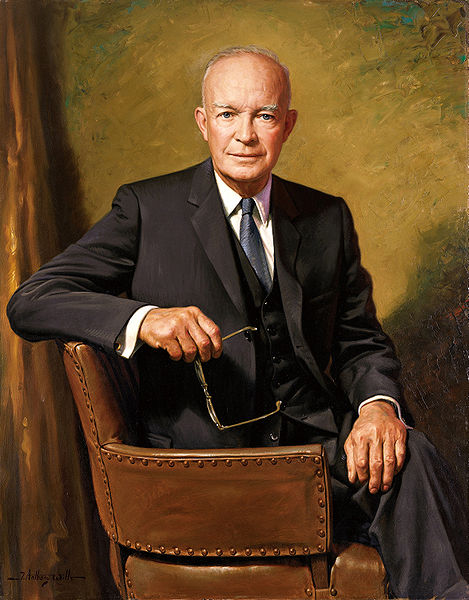 However, while it's rarely mentioned alongside this popular quote, President Eisenhower was writing in response to his brother Edgar, who had accused him of pursuing the same policies in foreign relations and many domestic policies as the previous administration, that of Democrat Harry Truman. In context, it would appear that President Eisenhower's reasons for defending the pursuit of those programs had little or in some cases perhaps even nothing whatsoever to do with whether or not he believed in their being wholly good programs. Rather, as he wrote in that same letter, "the Federal government cannot avoid or escape responsibilities which the mass of the people firmly believe should be undertaken by it"2. The point was that the people believe those programs to be the proper business of the government and so it would be folly for him to end the programs demanded by the people. It was not necessarily that he personally agreed with all of the programs, it was that he was a representative of a people whom he knew to have given him no mandate to end any of those safety net programs.
It is clear that President Eisenhower supported some (if not all) safety net programs. For instance, in his 1953 State of the Union address to Congress, he included a recognition of the need for at least certain social services and safeguards.
"This administration is profoundly aware of two great needs born of our living in a complex industrial economy. First, the individual citizen must have safeguards against personal disaster inflicted by forces beyond his control; second, the welfare of the people demands effective and economical performance by the Government of certain indispensable social services."3It's also clear that his budgets put federal money where his mouth was in that regard, as the frequent cuts through his first term mainly hit the defense sections while social security steadily grew. Those reductions in defense spending bring to mind another of his famous quotes from the Chance for Peace speech,
"Every gun that is made, every warship launched, every rocket fired signifies, in the final sense, a theft from those who hunger and are not fed, those who are cold and are not clothed. This world in arms is not spending money alone.
It is spending the sweat of its laborers, the genius of its scientists, the hopes of its children."4Even through his second term, while defense spending returned to rising, by the time of his final budget defense spending still had not returned to the level of his first budget. This lowered spending suggests that he really meant it and worked to avoid spending more than he felt was necessary ... so as to avoid committing even more "theft from those who hunger and are not fed". However, like so many quotes from times past, one could easily read too much into President Eisenhower's lamenting of the resources spent on the military. Remember, this was a retired general speaking. He wasn't about to unilaterally disarm while others didn't. Nor would he likely have accepted such a massive reduction in forces that our ability to respond to unanticipated threats would be crippled. Instead, he only hoped to reach agreement with opposing powers that would reduce the scale of military spending with potential aspects such as, "limitation, by absolute numbers or by an agreed international ratio, of the sizes of the military and security forces of all nations."4 One can not properly read an opposition to all military spending into this retired general's statement. On the contrary, he later wrote in a letter,
"My great difficulty is in realizing that anyone in this country, even for partisan reasons, would entertain for a moment the thought that I would let our defense structure be undermined to a danger point. What I am trying to do is to keep a clearly adequate security and our economy sound, preserving the integrity of our dollar both at home and abroad. At the same time we must not drain off from our economy so much money in taxes that we diminish too markedly the private funds needed for expansion."5Clearly he was not universally opposed to military spending but rather concerned with prudent allocation, i.e. with not allowing unconstrained military spending to swallow up too large a portion of our resources.
"Our problem is to achieve adequate military strength within the limits of endurable strain upon our economy. To amass military power without regard to our economic capacity would be to defend ourselves against one kind of disaster by inviting another."3It was not a cut at all costs imperative, as he acknowledged the value of some military and social spending, "balancing the budget is not so important as the performance of those governmental functions that are designed to sustain our security and promote economic development."6 But like today's laissez-faire proponents, he believed that money spent by the government would drain off our economy and diminish the private sector. And like today's inflation hawks, he believed that "a rash of spending ... would encourage inflation".7 And conversely he believed that restraining spending would "do much to sustain the integrity and purchasing power of our dollar".8 He considered deficits "one of the inciting causes" of inflation.8 Reading Eisenhower's various comments on balancing the budget, one is struck by how similar his reasoning is to conservatives of later years except that he stressed the importance of reducing spending before reducing taxes,9 whereas current Republicans are willing to reverse that order.
Unfortunately for President Eisenhower's economic legacy, his budget cuts were not without costs of their own. Inflation-adjusted median income grew by just 1.83% from 1953 to 1960 as opposed to the 9.17% from 1947 (start of available data) to 1952 under Truman or the 20.08% from 1961 to 1968 under Kennedy/Johnson.10 And unemployment under his watch rose from 2.6% to 6.9%. While he did manage multiple balanced budgets with his fiscal restraint, he did so to the detriment of the economy that he sought to improve.

Sources:
- 1956 Republican Party Platform
- http://www.eisenhowermemorial.org/presidential-papers/first-term/documents/1147.cfm
- 1953 State of the Union address to Congress
- Chance for Peace
- http://www.eisenhowermemorial.org/presidential-papers/second-term/documents/1107.cfm
- http://www.eisenhowermemorial.org/presidential-papers/second-term/documents/497.cfm
- http://www.eisenhowermemorial.org/presidential-papers/second-term/documents/1114.cfm
- http://www.eisenhowermemorial.org/presidential-papers/second-term/documents/1042.cfm
- http://www.eisenhowermemorial.org/presidential-papers/first-term/documents/279.cfm
- https://www.census.gov/hhes/www/income/data/historical/people/2011/P04_2011.xls
Sunday, October 7, 2012
Unemployment and Party Policies: There's a Correlation, But What's the Causation?
Can we conclude failed / succeeded party policies from the following chart? Or did the policies change too much from administration to administration even within parties to attribute this trend to a policy set typical of either party?


This being unemployment, down is good ... a reduction in unemployment. The chart starts with the first President whose full term is entirely within the standard BLS/FRED "unrate" data. Figures are calculated by starting with the first full month of the administration and going to the first full month of the next administration or to the latest available month in the case of the current administration.
As a group since Eisenhower, Republican Presidents averaged a 2.05 point increase in unemployment per administration. Meanwhile Democrats averaged a 1.42 point reduction in unemployment per administration.
From all that I've seen beyond just this chart, I'm tempted to say that this chart illustrates the economic impact mainly of two things: Republican drives to cut spending to balance the budget and Democratic drives to strengthen the safety net resulting in more fuel to the consumer engine. However, I hesitate to state that as a definitive explanation at this point. It's more of a rough hypothesis.
Friday, October 5, 2012
The Cost of Balanced Budgets and a Longer View on Presidents and Jobs From Ike To 2012
I'd usually heard the 50s described as more or less a golden era of rising prosperity. But till recently I tended to skip over digging into that decade's economic data to focus on the Great Depression up through World War II (when not mucking about the peaks and valleys of more recent times). So I have to admit this chart surprised me.
I was expecting that adding in the Republican Presidents before Reagan would show that prior to Trickle-down / Supply-side economics / Reaganomics infecting the Republican party, they'd done better. I expected to be illustrating the post-Depression glory days of the Republican party via Ike, Nixon, and Ford. Instead, the data gave me what we see above. In jobs, Nixon and Ford both did worse than Johnson, Carter, and Clinton. While Nixon and Ford did better than Obama's marks for his full term so far, they each did worse than during his tepid recovery span from February 2010 on to the latest data. And then there's Ike -- whom we admire -- down there with the likes of the Bushes. I didn't want to see that. Frankly, I wanted to believe Ike pulled off the Clinton trick of balancing the budget while improving employment. But I can't deny the data.
If we look a bit further back, before the dates in the data used above to put payroll growth in perspective via population growth, we can at least compare Ike's raw payroll figures to those from FDR (since 1939) and Truman, but that only rules out claiming Ike's dismal jobs performance as part of a longer trend.
It's not a pretty picture for Ike, which I'm sad to see. Thankfully there's still much to admire from President Eisenhower in the highway system and his work for civil rights. I still like Ike. I still think I'd have voted for him if I'd been old enough at the time. But his economic record is tarnished.
In his defense, President Eisenhower did start his term with a 2.6% unemployment rate during that first full month. It's hard to improve on 2.6% unemployment. Still, unemployment rose dramatically to 6.9% by the first full month of his successor's term. Ike's shift: +165% unemployment. That's a rather lousy fumble. And while the Eisenhower years saw increasing family incomes, the same can be said for the Kennedy / Johnson years except without the rising unemployment, as over the course of their span they reduced that rate from the 6.9% that Eisenhower left them back down to 3.4% by the end of Johnson's Presidency.
So what went wrong? Let's look at the modern history of balanced budgets:
In case after case, budgets balanced with spending cuts have brought on recession. And now the Republicans are once again pushing us to balance the budget with dramatic spending cuts. Democrats may not be leading the charge, but Obama like FDR is far too willing to accept the Republican push for cuts. If we don't turn away from this push to slash budgets, previous experience shows us it will hurt the economy. When we make the debt more manageable by growing our economy such that the debt shrinks by comparison, that's tended to work out well. When we clumsily attempt to tackle the debt directly by slashing spending to balance the budget in the hopes a primary surplus, the records shows it tends to work out poorly.
 |
| starting with Ike, the first President fully covered in the monthly POP data; to June 2012 |
If we look a bit further back, before the dates in the data used above to put payroll growth in perspective via population growth, we can at least compare Ike's raw payroll figures to those from FDR (since 1939) and Truman, but that only rules out claiming Ike's dismal jobs performance as part of a longer trend.
 |
| Ike's sad job numbers with context: at least he's not Bush II |
It's not a pretty picture for Ike, which I'm sad to see. Thankfully there's still much to admire from President Eisenhower in the highway system and his work for civil rights. I still like Ike. I still think I'd have voted for him if I'd been old enough at the time. But his economic record is tarnished.
In his defense, President Eisenhower did start his term with a 2.6% unemployment rate during that first full month. It's hard to improve on 2.6% unemployment. Still, unemployment rose dramatically to 6.9% by the first full month of his successor's term. Ike's shift: +165% unemployment. That's a rather lousy fumble. And while the Eisenhower years saw increasing family incomes, the same can be said for the Kennedy / Johnson years except without the rising unemployment, as over the course of their span they reduced that rate from the 6.9% that Eisenhower left them back down to 3.4% by the end of Johnson's Presidency.
So what went wrong? Let's look at the modern history of balanced budgets:
- At Republican urging, FDR tried to balance the budget with spending cuts and it brought us the Recession of 1937-38.
- After World War II we saw dramatic cutbacks in spending with balanced budgets in 1947 through 1949 and the recessions in 1945 and 1949. (Of course, the war spending was unsustainable; there was probably no way to avoid recession in the late 1940s.)
- Truman balanced the budget in 1951. But like the later Clinton-era balanced budgets this one was done while expanding federal outlays ... rather swiftly increasing from the 1948 lows. Then after we slowed spending at the end of the Korean War, we got the recession of 1953.
- Eisenhower balanced the budget in 1956 and 1957 and we got the Recession of 1957.
- Eisenhower balanced the budget again in 1960 and we got the Recession of 1960.
- Nixon balanced the budget in 1969 and we got the Recession of 1970.
- While Clinton balanced the budget in 1998 lasting through Bush's first budget in 2001, the balancing in these years was done without reducing the growth of federal outlays but rather through moderate increase of tax rates. As such, this particular instance was thoroughly different from most previous balancing of the budget (except Truman's).
There were also some recessions that didn't correspond to these balanced budgets: the oil shock under Nixon, the extremely high interest rates under Reagan, the S&L crisis under Bush I, the Dot-Com crash under Clinton and Bush II, and the housing/finance crash under Bush II. I'm not suggesting that all recessions are caused by cutting to achieve balanced budgets. However, it would seem that balancing our national budget via cuts -- even if only in inflation-adjusted terms as in 1960 and 1969 -- tends to lead to recession.
The impact of Eisenhower's budget balancing exploits are particularly of interest for its parallel to job losses in the Great Recession. Private payrolls dropped by 2.385 million between August 1957 and June 1958, a 5.26% decline. By comparison, that's just barely below the 5.47% decline during the worst job-loss months of the Great Recession from August 2008 through June 2009. Remember that saying about doing the same thing and expecting different results. If we implement massive cutbacks like Eisenhower with our sequestration fiscal cliff, we can expect yet another massive fall just like the Eisenhower recession ... and we've not climbed far enough back from the jagged rocks as it is.
In case after case, budgets balanced with spending cuts have brought on recession. And now the Republicans are once again pushing us to balance the budget with dramatic spending cuts. Democrats may not be leading the charge, but Obama like FDR is far too willing to accept the Republican push for cuts. If we don't turn away from this push to slash budgets, previous experience shows us it will hurt the economy. When we make the debt more manageable by growing our economy such that the debt shrinks by comparison, that's tended to work out well. When we clumsily attempt to tackle the debt directly by slashing spending to balance the budget in the hopes a primary surplus, the records shows it tends to work out poorly.
Wednesday, September 12, 2012
The Economic Engine: Is It Fixed?
If our car had a busted transmission, we base whether to call it fixed by how it responds when it's in drive and we press on the gas. Does it go forward when we apply gas? Does it go faster when we apply more gas? If so, then it's fixed ... even when it happens to be going slower on the on-ramp than it was when the transmission first broke on the highway.

We don't base whether to call it fixed on its speed at the moment or how full its gas tank is. That'd be ridiculous.
Right now the Republican House is pulling back on our foot ... keeping us from putting the pedal to the metal. The Fed Chairman filled the tank with monetary measures. The President didn't even try to floor it, but he's tried to apply a bit more gas than the current House is letting him apply with fiscal measures. The 111th Congress was applying more gas than the 112th Congress is applying.
We could be going faster if we applied more gas. That we're not putting the pedal to the metal doesn't mean the car isn't fixed.

Given the output gap between actual and potential GDP, we're driving below the speed limit. The potential GDP is the speed limit. Any faster than that and we're liable to be pulled over and get a ticket. But we could be going faster. There's a good bit of room to step on the gas and get ourselves up to speed. That would require the House to stop holding us back from applying the gas it'd take to get up to speed.
Monday, September 10, 2012
Why do Right-wingers Hate President Obama?
Despite being sufficiently conservative to annoy no small number of staunch liberals and despite his stances broadly matching many of the most common views of middle America, President Obama has become the right-wing's bogeyman to explain away everything that conflicts with their world view. Actually facing facts would require them to change their world view, and they don't want that. This is how satirist Jon Stewart touched upon so much truth when he reviewed Eastwood's convention speech and noted,

"But I could never wrap my head around why the world and the President that Republicans describe bear so little resemblance to the world and the President that I experience. And now I know why. There is a President Obama that only Republicans can see."
The notions of trickle-down have been thoroughly shown to not only fail but fail badly. Upper-bracket tax cuts have been a massive flop. We've had them for over a decade. If they worked to create jobs, we'd be rolling in jobs by now. Deregulation returns the system to a level of instability that's bad for business, lowering the ability to expect what will happen with investments. But facing all of that might -- or even any of that -- might require them to admit that maybe their right-wing approach just isn't right. It might require them to re-think a world view in which they're emotionally invested. So instead, they need someone -- anyone -- to rail against for allegedly embodying all that they fear and want to believe must really be at fault.
Here's how it works in the fantasy land of right-wing escapism to explain why their policies must not actually be the root cause of most of our troubles:
- We've got lingering unemployment? Let's not face that Republican's favorite idea of deregulation was a major factor in creating that; instead, it must be Obama's fault.
- We've got debt? Let's not face that it was mostly accumulated under Republicans and by a wide margin at that; instead, it must be Obama's fault.
- We've got a deficit? Let's not face that spending has grown slower under the current President than under any recent Republican; instead, it must be Obama's fault. Facts and figures be damned; he must be a big spender despite what all those charts show.
- We haven't fully brought our troops home from a war started under a Republican and that has mostly been managed by that Republican administration; it must be Obama's fault.
- Analysts expect the Affordable Care Act that Republicans have opposed to really save money by cutting waste without reducing quality of care while still keeping healthcare a largely private system? Nah, that can't be, they say. Surely, since Republicans have opposed it and it involves those regulations [eek!], Obamacare must be big spending govt socialized medicine. Facts be damned! And fact-checkers along with 'em!
And if one should dare to show solid proof that it was really Republicans at fault for any of these things? Why then according to today's Republicans, they must be a left-winger -- maybe even a leftist -- and their sources must be partisan, no matter how much those sources may have been previously recognized as non-partisan, no matter how much those sources are well documented.
Thursday, September 6, 2012

Friday, August 31, 2012
Clint Eastwood at the RNC: Bashing W?
OK, they didn't intend him to make comments that any reasonable observer would take as a slam of the most recent Republican President, did they?


That sure sounded like a slam on Bush II. Did Eastwood forget that it was a Republican President who took us into Afghanistan and oversaw most of the length of the operations there? If one were going to make a dig against the wisdom of going into Afghanistan, the only administration that can reasonably be a dig against is the Bush II administration.
"But we did it ..." Yes, Republicans did that.
While perhaps it could have been handled differently, there were valid reasons for going into Afghanistan despite the way it turned out for Russia. Going after Al Qaeda at their training camps was one of W's more reasonable actions, something which can't be said for the Iraq diversion. But whether one finds it wisdom or folly, going into Afghanistan was most certainly on the plate of Bush II.
Wednesday, August 29, 2012
Clinton Warned Us The Republican Tax Cuts Would Do This
Clinton called it: "The Republican tax cuts, he warned with eerie prescience, would return America to a period of 'deficit upon deficit' that culminated in 'the worst recession since the Great Depression.'"
Friday, August 24, 2012
When Republicans Were Great: The Once and Future GOP?
Where would you guess the following quote came from?
 If you guessed the 1956 Republican Party Platform, congratulations! Once upon a time, Republicans stood for far-reaching advances in matters of basic human needs. Once upon a time, Republicans stood for expansion of social security. Once upon a time, Republicans stood for broadened coverage in unemployment insurance. Once upon a time, Republicans stood for improved housing. Once upon a time, Republicans stood for better health protection for all our people. Once upon a time, Republicans stood for being warmly responsive to the urgent social and economic problems of our people.
Over the past several decades, the "Reagan Revolution" political dogma stamped out what was left of those golden days when traditional, proven, sensible, responsible, balanced policy drove the Republican party. The party leadership and much of its base turned against the policies that built our economic strength on a larger middle-class as the engine of commerce. At this point, Republicans stand for ignoring basic human needs. Current Republicans stand for privatizing social security and turning seniors over to the topsy-turvy stock market as fodder for those who would like nothing better than to gamble with those funds. Now Republicans stand in the way of extending unemployment insurance. Today's Republicans seek every opportunity to repeal better health protection for more of our people. Contemporary Republicans stand for leaving the urgent social and economic problems of our people to the whims of the short-sighted, momentary-profit-driven market. And if answering their social and economic problems should happen to be thought unprofitable in the short-term, post-Reagan Republicans see no reason not to sacrifice the long term good of the people.
It doesn't have to be that way. Obviously. The Grand Old Party really was grand before the Reagan Revolution. It could be again. All it would need to do is rediscover traditional American values -- the old-school Republican values -- and repudiate the "starve the beast" platform of ever lower taxes in an effort to force abandonment of social and economic progress. Balancing the budget in the average year isn't bad and was even embraced in the 1956 platform too, but today's GOP pitches snake oil when it claims the only way to balance the budget is to cut. The party used to know better. There are values it should rediscover from it's past, such as:
"We are proud of and shall continue our far-reaching and sound advances in matters of basic human needs—expansion of social security—broadened coverage in unemployment insurance —improved housing—and better health protection for all our people. We are determined that our government remain warmly responsive to the urgent social and economic problems of our people."
Over the past several decades, the "Reagan Revolution" political dogma stamped out what was left of those golden days when traditional, proven, sensible, responsible, balanced policy drove the Republican party. The party leadership and much of its base turned against the policies that built our economic strength on a larger middle-class as the engine of commerce. At this point, Republicans stand for ignoring basic human needs. Current Republicans stand for privatizing social security and turning seniors over to the topsy-turvy stock market as fodder for those who would like nothing better than to gamble with those funds. Now Republicans stand in the way of extending unemployment insurance. Today's Republicans seek every opportunity to repeal better health protection for more of our people. Contemporary Republicans stand for leaving the urgent social and economic problems of our people to the whims of the short-sighted, momentary-profit-driven market. And if answering their social and economic problems should happen to be thought unprofitable in the short-term, post-Reagan Republicans see no reason not to sacrifice the long term good of the people.
It doesn't have to be that way. Obviously. The Grand Old Party really was grand before the Reagan Revolution. It could be again. All it would need to do is rediscover traditional American values -- the old-school Republican values -- and repudiate the "starve the beast" platform of ever lower taxes in an effort to force abandonment of social and economic progress. Balancing the budget in the average year isn't bad and was even embraced in the 1956 platform too, but today's GOP pitches snake oil when it claims the only way to balance the budget is to cut. The party used to know better. There are values it should rediscover from it's past, such as:
- "Republican action created the Department of Health, Education and Welfare as the first new Federal department in 40 years, to raise the continuing consideration of these problems for the first time to the highest council of Government, the President's Cabinet."
- "The Republican Party will renew its efforts to enact a program based on sound principles of need and designed to encourage increased state and local efforts to build more classrooms."
- "Stimulate improved job safety of our workers, through assistance to the States, employees and employers;"
- "Protect by law, the assets of employee welfare and benefit plans so that workers who are the beneficiaries can be assured of their rightful benefits;"
- "Assure equal pay for equal work regardless of Sex;"
- "Provide assistance to improve the economic conditions of areas faced with persistent and substantial unemployment;"
- "We have supported the distribution of free vaccine to protect millions of children against dreaded polio."
- "Republican leadership has enlarged Federal assistance for construction of hospitals, emphasizing low-cost care of chronic diseases and the special problems of older persons, and increased Federal aid for medical care of the needy."
- "We have asked the largest increase in research funds ever sought in one year to intensify attacks on cancer, mental illness, heart disease and other dread diseases."
- "We have supported measures that have made more housing available than ever before in history, reduced urban slums in local-federal partnership, stimulated record home ownership, and authorized additional low-rent public housing."
- "We shall continue to seek extension and perfection of a sound social security system."
Traditional American values. Every one of them. Those are values the Republican party once knew. The heartless ideologues of the Reagan Revolution have lead the GOP astray. But parties change. There's still time for the GOP to reclaim those traditional values and learn to rediscover the art of appropriate taxation instead of always starving our government and undermining its work of building infrastructure, commerce, and a growing, prospering middle class. Building a safety net under our people, working to lift up the least affluent, and strengthening the middle class leads to strong, lasting, stable prosperity for us all. Wealth grows best on a diet of steady commerce from a rising middle class. To get there, we must pull our heads out of the hole that is cutting at all costs. Budgets must be balanced by growth ... not by slash and burn. As the 1956 GOP platform quoted President Eisenhower, "America does not prosper unless all Americans prosper. Government must have a heart as well as a head."
Subscribe to:
Posts (Atom)