Showing posts with label social security. Show all posts

Wednesday, October 10, 2012

Dwight D Eisenhower, A Proud But Mixed Legacy

Every gun that is made, every warship launched, every rocket fired signifies, in the final sense, a theft from those who hunger and are not fed, those who are cold and are not clothed. This world in arms is not spending money alone. It is spending the sweat of its laborers, the genius of its scientists, the hopes of its children. - President Eisenhower, 1953President Eisenhower, as quoted in the 1956 Republican Party Platform, gives a rousing call for shared prosperity, cooperation, and balancing logic with empathy:
"The individual is of supreme importance.
The spirit of our people is the strength of our nation.
America does not prosper unless all Americans prosper.
Government must have a heart as well as a head.
Courage in principle, cooperation in practice make freedom positive.
To stay free, we must stay strong."1
Here was a Republican who expanded Social Security, accelerated desegregation of the armed forces, proposed and ultimately signed important civil rights legislation, and derided those like today's Republican leadership who would threaten the social safety net. It's well known that he wrote,
"Should any political party attempt to abolish social security, unemployment insurance, and eliminate labor laws and farm programs, you would not hear of that party again in our political history. There is a tiny splinter group, of course, that believes you can do these things. Among them are H. L. Hunt (you possibly know his background), a few other Texas oil millionaires, and an occasional politician or business man from other areas. Their number is negligible and they are stupid."2
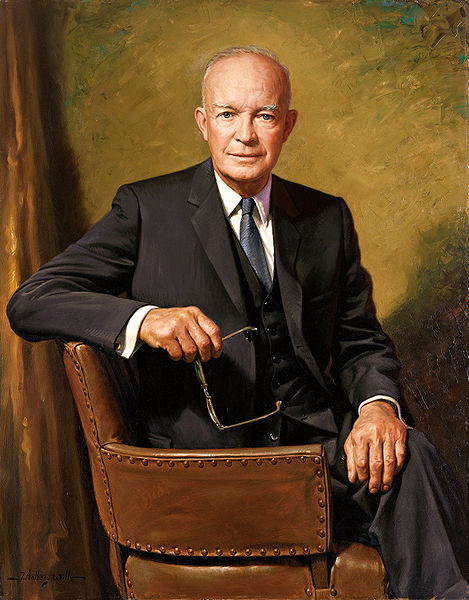
However, while it's rarely mentioned alongside this popular quote, President Eisenhower was writing in response to his brother Edgar, who had accused him of pursuing the same policies in foreign relations and many domestic policies as the previous administration, that of Democrat Harry Truman. In context, it would appear that President Eisenhower's reasons for defending the pursuit of those programs had little or in some cases perhaps even nothing whatsoever to do with whether or not he believed in their being wholly good programs. Rather, as he wrote in that same letter, "the Federal government cannot avoid or escape responsibilities which the mass of the people firmly believe should be undertaken by it"2. The point was that the people believe those programs to be the proper business of the government and so it would be folly for him to end the programs demanded by the people. It was not necessarily that he personally agreed with all of the programs, it was that he was a representative of a people whom he knew to have given him no mandate to end any of those safety net programs.

It is clear that President Eisenhower supported some (if not all) safety net programs. For instance, in his 1953 State of the Union address to Congress, he included a recognition of the need for at least certain social services and safeguards.
"This administration is profoundly aware of two great needs born of our living in a complex industrial economy. First, the individual citizen must have safeguards against personal disaster inflicted by forces beyond his control; second, the welfare of the people demands effective and economical performance by the Government of certain indispensable social services."3
It's also clear that his budgets put federal money where his mouth was in that regard, as the frequent cuts through his first term mainly hit the defense sections while social security steadily grew. Those reductions in defense spending bring to mind another of his famous quotes from the Chance for Peace speech,
"Every gun that is made, every warship launched, every rocket fired signifies, in the final sense, a theft from those who hunger and are not fed, those who are cold and are not clothed. This world in arms is not spending money alone. 
It is spending the sweat of its laborers, the genius of its scientists, the hopes of its children."4
Even through his second term, while defense spending returned to rising, by the time of his final budget defense spending still had not returned to the level of his first budget. This lowered spending suggests that he really meant it and worked to avoid spending more than he felt was necessary ... so as to avoid committing even more "theft from those who hunger and are not fed". However, like so many quotes from times past, one could easily read too much into President Eisenhower's lamenting of the resources spent on the military. Remember, this was a retired general speaking. He wasn't about to unilaterally disarm while others didn't. Nor would he likely have accepted such a massive reduction in forces that our ability to respond to unanticipated threats would be crippled. Instead, he only hoped to reach agreement with opposing powers that would reduce the scale of military spending with potential aspects such as, "limitation, by absolute numbers or by an agreed international ratio, of the sizes of the military and security forces of all nations."4 One can not properly read an opposition to all military spending into this retired general's statement. On the contrary, he later wrote in a letter,
"My great difficulty is in realizing that anyone in this country, even for partisan reasons, would entertain for a moment the thought that I would let our defense structure be undermined to a danger point. What I am trying to do is to keep a clearly adequate security and our economy sound, preserving the integrity of our dollar both at home and abroad. At the same time we must not drain off from our economy so much money in taxes that we diminish too markedly the private funds needed for expansion."5
Clearly he was not universally opposed to military spending but rather concerned with prudent allocation, i.e. with not allowing unconstrained military spending to swallow up too large a portion of our resources.
"Our problem is to achieve adequate military strength within the limits of endurable strain upon our economy. To amass military power without regard to our economic capacity would be to defend ourselves against one kind of disaster by inviting another."3
It was not a cut at all costs imperative, as he acknowledged the value of some military and social spending, "balancing the budget is not so important as the performance of those governmental functions that are designed to sustain our security and promote economic development."But like today's laissez-faire proponents, he believed that money spent by the government would drain off our economy and diminish the private sector. And like today's inflation hawks, he believed that "a rash of spending ... would encourage inflation".7 And conversely he believed that restraining spending would "do much to sustain the integrity and purchasing power of our dollar".8 He considered deficits "one of the inciting causes" of inflation.8 Reading Eisenhower's various comments on balancing the budget, one is struck by how similar his reasoning is to conservatives of later years except that he stressed the importance of reducing spending before reducing taxes,9 whereas current Republicans are willing to reverse that order.

Unfortunately for President Eisenhower's economic legacy, his budget cuts were not without costs of their own. Inflation-adjusted median income grew by just 1.83% from 1953 to 1960 as opposed to the 9.17% from 1947 (start of available data) to 1952 under Truman or the 20.08% from 1961 to 1968 under Kennedy/Johnson.10 And unemployment under his watch rose from 2.6% to 6.9%. While he did manage multiple balanced budgets with his fiscal restraint, he did so to the detriment of the economy that he sought to improve.

Civilian unemployment rate during President Eisenhower's term


Sources:
  1. 1956 Republican Party Platform
  2. http://www.eisenhowermemorial.org/presidential-papers/first-term/documents/1147.cfm
  3. 1953 State of the Union address to Congress
  4. Chance for Peace
  5. http://www.eisenhowermemorial.org/presidential-papers/second-term/documents/1107.cfm
  6. http://www.eisenhowermemorial.org/presidential-papers/second-term/documents/497.cfm
  7. http://www.eisenhowermemorial.org/presidential-papers/second-term/documents/1114.cfm
  8. http://www.eisenhowermemorial.org/presidential-papers/second-term/documents/1042.cfm
  9. http://www.eisenhowermemorial.org/presidential-papers/first-term/documents/279.cfm
  10. https://www.census.gov/hhes/www/income/data/historical/people/2011/P04_2011.xls

Wednesday, September 26, 2012

Social Security and the Elderly Bread: Individualistic Solutions Inferior, Except When The World Ends ... and Then Who Would Be Counting?

John Kay reminds us of an excellent analysis of why we implement "welfare" programs in, "The welfare state’s a worthy Ponzi scheme", from which a highlight follows:

Social security is a means of inter-generational transfer. The only bread fit to eat is bread baked today: but why should today’s bakers feed the retired bakers of yesteryear? Why should we look after old people, who can no longer do anything for us? 
... We feed the generations of our parents and grandparents in the expectation future generations will come along and do the same for us. ... One day, the world will end and the last generation of workers will have been cheated of their expectation of a peaceful retirement. ... 
A brilliant analysis of the issues was provided half a century ago by Paul Samuelson, the great economist – an analysis that might have received wider attention had it not been written in mathematics and published under the uninviting title of “An exact consumption-loan model of interest with or without the social contrivance of money”. 
The only individualistic solutions to the problem of ageing are to store bread to eat, or sell, when it is stale and you are old; or to take the opportunity when young to bribe younger people to look after you in your dotage. Samuelson showed these outcomes were inferior to the outcome of the social security contract for every generation except the one alive on judgment day.

The rest of the article -- over at the Financial Times -- is also well worth the read, despite Kay's acceptance of the idea that "Ponzi scheme" can be reasonably applied to these social contracts. The designation of Ponzi scheme only applies to those plans that will fail even if everyone involved sticks to them and keeps going, failing because the scheme's earnings will necessarily be less than those promised in payout. Social security and the like will continue to function and pay out what's promised so long as our society sticks to them, administers them sensibly, and doesn't end. That's partially because we adjust the earnings / output to what can be done with the current demographic environment, but that makes it not qualify as a Ponzi scheme. The mere fact that someone won't be able to derive theoretical benefits after the society ends isn't enough to qualify as a Ponzi scheme. If it were, every transaction that isn't fulfilled instantly would be a Ponzi scheme.

Friday, August 24, 2012

When Republicans Were Great: The Once and Future GOP?

Where would you guess the following quote came from?
"We are proud of and shall continue our far-reaching and sound advances in matters of basic human needs—expansion of social security—broadened coverage in unemployment insurance —improved housing—and better health protection for all our people. We are determined that our government remain warmly responsive to the urgent social and economic problems of our people."
If you guessed the 1956 Republican Party Platform, congratulations! Once upon a time, Republicans stood for far-reaching advances in matters of basic human needs. Once upon a time, Republicans stood for expansion of social security. Once upon a time, Republicans stood for broadened coverage in unemployment insurance. Once upon a time, Republicans stood for improved housing. Once upon a time, Republicans stood for better health protection for all our people. Once upon a time, Republicans stood for being warmly responsive to the urgent social and economic problems of our people.

Over the past several decades, the "Reagan Revolution" political dogma stamped out what was left of those golden days when traditional, proven, sensible, responsible, balanced policy drove the Republican party. The party leadership and much of its base turned against the policies that built our economic strength on a larger middle-class as the engine of commerce. At this point, Republicans stand for ignoring basic human needs. Current Republicans stand for privatizing social security and turning seniors over to the topsy-turvy stock market as fodder for those who would like nothing better than to gamble with those funds. Now Republicans stand in the way of extending unemployment insurance. Today's Republicans seek every opportunity to repeal better health protection for more of our people. Contemporary Republicans stand for leaving the urgent social and economic problems of our people to the whims of the short-sighted, momentary-profit-driven market. And if answering their social and economic problems should happen to be thought unprofitable in the short-term, post-Reagan Republicans see no reason not to sacrifice the long term good of the people.

It doesn't have to be that way. Obviously. The Grand Old Party really was grand before the Reagan Revolution. It could be again. All it would need to do is rediscover traditional American values -- the old-school Republican values -- and repudiate the "starve the beast" platform of ever lower taxes in an effort to force abandonment of social and economic progress. Balancing the budget in the average year isn't bad and was even embraced in the 1956 platform too, but today's GOP pitches snake oil when it claims the only way to balance the budget is to cut. The party used to know better. There are values it should rediscover from it's past, such as:

  • "Republican action created the Department of Health, Education and Welfare as the first new Federal department in 40 years, to raise the continuing consideration of these problems for the first time to the highest council of Government, the President's Cabinet."
  • "The Republican Party will renew its efforts to enact a program based on sound principles of need and designed to encourage increased state and local efforts to build more classrooms."
  • "Stimulate improved job safety of our workers, through assistance to the States, employees and employers;"
  • "Protect by law, the assets of employee welfare and benefit plans so that workers who are the beneficiaries can be assured of their rightful benefits;"
  • "Assure equal pay for equal work regardless of Sex;"
  • "Provide assistance to improve the economic conditions of areas faced with persistent and substantial unemployment;"
  • "We have supported the distribution of free vaccine to protect millions of children against dreaded polio."
  • "Republican leadership has enlarged Federal assistance for construction of hospitals, emphasizing low-cost care of chronic diseases and the special problems of older persons, and increased Federal aid for medical care of the needy."
  • "We have asked the largest increase in research funds ever sought in one year to intensify attacks on cancer, mental illness, heart disease and other dread diseases."
  • "We have supported measures that have made more housing available than ever before in history, reduced urban slums in local-federal partnership, stimulated record home ownership, and authorized additional low-rent public housing."
  • "We shall continue to seek extension and perfection of a sound social security system."
Traditional American values. Every one of them. Those are values the Republican party once knew. The heartless ideologues of the Reagan Revolution have lead the GOP astray. But parties change. There's still time for the GOP to reclaim those traditional values and learn to rediscover the art of appropriate taxation instead of always starving our government and undermining its work of building infrastructure, commerce, and a growing, prospering middle class. Building a safety net under our people, working to lift up the least affluent, and strengthening the middle class leads to strong, lasting, stable prosperity for us all. Wealth grows best on a diet of steady commerce from a rising middle class. To get there, we must pull our heads out of the hole that is cutting at all costs. Budgets must be balanced by growth ... not by slash and burn. As the 1956 GOP platform quoted President Eisenhower, "America does not prosper unless all Americans prosper. Government must have a heart as well as a head."

Saturday, January 7, 2012

Just What Exactly Doesn't Benefit Everyone?

It's been said that, "any public institution that doesn't benefit everyone should not be paid by everyone."

Interesting idea, but much depends on how one judges "doesn't benefit everyone". For instance, housing subsidies can reasonably be described as benefiting everyone. How? Obviously they benefit the people getting the subsidies directly because those whose wages are too low to otherwise afford decent housing can then afford some approximation of decent housing. Obviously they benefit property owners in areas where there is a demand for housing but the costs of building/maintaining housing outpace the amount that can be paid by low wage earners ... thus helping make it economically viable for rental property investors to build properties to meet the need for housing. Less obviously, they also benefits all of the customers of companies that employ low wage earners, as it helps those companies keep their wages low and thus avoid raising prices for their goods and services.

Do you ever shop at a store that employs people for low wages? If so, you've almost certainly benefitted indirectly from housing assistance.

Further, housing assistance, food stamps, etc. reduce desperation, which helps avoid things like riots and property damage. That's good for anyone who own property. Do you own property? If so, then you've at least indirectly benefitted from housing assistance, food stamps, etc.

Do you hope to retire? If so, then you can reasonably expect to benefit from social security and Medicare. (Although you might not benefit at today's levels, assuming that the politically insane continue to thwart efforts to re-balance the income limit and continue to thwart things like universal healthcare that -- if done even vaguely close to half as well as most of the rest of the world -- should reduce our percentage of GDP/capita spent on healthcare ... which would certainly benefit all of us.)

Speaking of healthcare, healthy workers are a huge boon to employers ... they don't have to worry about their skilled employees being out so much. That's a giant monetary benefit to employers and by extension some benefit to all fellow employees as a result of the employer being more stable because of the healthy workforce.

So, what exactly is this public institution that supposedly doesn't benefit everyone?

We live in a very interconnected society. Short of hermits, I don't think you'll find anyone who isn't benefitted by most every program of any significant size in some way ... even if only indirectly.

Tuesday, September 27, 2011

We Could Pay Off The Debt. But Should We?

We could do it. If we wanted to, we could eliminate the deficit with taxes alone. The real question is whether we should.

Debt in perspective
Yes, you've probably heard that we can't. You've probably heard the claim that the deficit is unmanageable. You've probably heard the claim that the debt is some grand, unapproachable amount that we already can't possibly hope to pay off. You've probably heard the claims that our debt is so high there aren't enough assets or income in the country to cover it.

They're flat-out false. The only question is whether they believe what they're saying or they're purposefully lying.

Here are the numbers from the census data, the treasury, the fed, and the standard deficit projection:

  • Number of households in 2010: 118,682,000
  • Mean 2010 household income in 2010 dollars: $67,530
  • 9/23/2011 current debt: $14.7 trillion
  • Projected 2011 deficit: roughly $1.3 trillion
  • Household 2010 net worth: roughly $57 trillion

So take those numbers above and we can see that:
  • Net worth / household: $480,275
  • Federal debt / household: $123,861
  • Net worth after US debt / household: $356,414 (far higher than median net worth)
  • National income / household: $67,530
  • Federal deficit / household: $10,954
  • Net income after deficit: $56,574 (significantly higher than median income)
  • Deficit / income / household: 16.2%

The particular items of interest here are: 
  • $356,414 dollars left over if we were to pay all all federal debt from all household net worth today
  • 16.2% as the mean increase required to eliminate the deficit with tax increases alone

As $356,414 is far above the median net worth, most people would say that's far from broke. There would be lots of problems with actually liquidating private net worth, of course, so that's strictly hypothetical. The fact remains, however, that there is enough household net worth in the US to do it and still have quite a bit of wealth. Just because it isn't something we want to do doesn't mean it couldn't be done.

The 16.2% seems like a massive tax increase. But then consider that we've had higher taxes than that before. It wouldn't be all that bad if such an increase were done in a progressive manner. For the bottom 50% of taxpayers, losing 16.2% more of income would be catastrophic. But together they only make about 12.75% of total AGI, so managing without the bottom 50% isn't so hard. For the top 1% such an increase would be easily survivable and still far below what folks with such incomes would have paid in the 1950s and 60s. Based on the AGI's if we taxed the top 1% an additional 40%, that alone would cover over half the deficit. Just for a rough example, if we were to raise effective tax rates by 40% on the top 1%, 15% on the rest of the top 5%, 10% on the rest of the top 10%, 5% on the rest of the top 25%, and 2% on the rest of the top 50%, that would net us an additional $1.38 trillion. That'd be well more than enough to cover the deficit. Whether we want to do something like that or not, the fact remains that it could be done. If we collectively wanted to, we clearly could close the deficit with tax increases alone.

If you don't believe my numbers, please look them up yourself. If you don't believe these basic calculations, please pull out your calculator or spreadsheet and run them yourself. You'll find the same thing. We could cancel out the deficit if we wanted to. And we could pay off the debt if we really wanted to. That's part of why our debt is an international safe-haven investment at very low interest rates. But there's another side to the story. Do we really want to have no national debt?

2010 Intragovernmental Holdings
Of that $14.7 trillion, $4.6 trillion is intragovernmental holdings. Over $2.6 trillion is held by the Social Security trust fund alone. Social Security needs someplace secure to hold that cash till it's needed. We don't want them gambling it on stocks or volatile commodities like gold or oil. Even if the rest of the world weren't seeing lots of instability, U.S. Treasuries are the only reasonable option. That means our federal govt must borrow at least enough to be able give the Social Security trust fund a safe place to invest. The same holds true for at least most of the rest of intragovernmental holdings, many of which are insurance or retirement accounts. We don't want them anywhere less safe; and anywhere else is less safe.

So far, we've identified roughly $4.6 trillion of debt that we want right where it is. It would be senseless to force ourselves to find alternatives less secure than the full faith and credit of our own government for those holdings.

Holders of debt, Dec 2010
The rest? As of the end of 2010, there was $802 billion in pension funds. Shall we tell all the pensioners their funds have to be less secure because our debt hawks don't want us to have govt debt anymore? There's $517 billion held by state and local govts. Shall we force our other levels of govt to engage in risky speculation? Depository institutions (i.e., banks) hold $323 billion. Didn't we already get burned by letting banks increase their risk? Do we really want to go there? Wouldn't that be exactly the opposite direction from where we've been trying to push the financial industry? Insurance companies hold $244 billion. Guess why they've put it into Treasuries ... because they need the stability in order to keep insuring us without entirely relying on risky sources to back up our claims. Then there's another $2,046 billion held among mutual funds, savings bonds, and other investors. All of whom look to Treasuries for low-risk investments to balance out our riskier investments with some safe, guaranteed income. Shall we deny all our investors -- both wealthy folks and the grandmother nearing retirement -- the opportunity to choose additional investment beyond Social Security that's backed by the full faith and credit of our govt? To stop issuing federal debt would be to say, "No, you may be ready to retire and seeking to move your funds out of risky assets, but we're not going to let you have this guaranteed income option." Do we really want to say that? Seriously?

What's that leave? The foreign portion, under a third of our debt. That's the part we could seriously consider. That's the part we could pay off without forcing our own govt institutions, companies, and individuals to shift all of their investments into riskier options. But what does that part mean to us? Foreign investments aren't invested in our debt because of attractive rates to them. Quite the opposite; they could easily choose any number of investments with higher rates. But those higher rates all come with more risk. We're the place nations stow cash in case everything else fails, safer than burying it. It isn't about making money off us; it's about making sure they've got enough money socked away where it is more certain to be available than any other option. It's about stability. That means we're issuing debt at very low rates, lower than ordinary inflation. After factoring for inflation, all the world is literally paying us to hold their money safely for them. Why should we turn that down instead of using it to improve our infrastructure and lower our domestic cost of doing business?