
Thursday, March 13, 2014
Not So Much With The Spending
Real government consumption expenditures and gross investment as a share of real GDP since 1950.


What We Should Have Done With The Banks (Hint: It Isn't Letting Them Collapse)
There are still people suggesting we should have let more banks collapse, apparently rekindled by discussions of Wall Street bonuses totaling more than the annual pay of all minimum wage workers.
Per Hyman Minsky in "Stabilizing an Unstable Economy",
We arguably should have required that in each bank to be bailed out all the major executives must be fired and thoroughly investigated ... as a condition of the bailout. That was the job that should have been done but wasn't.
Per Hyman Minsky in "Stabilizing an Unstable Economy",
"There is no possibility that we can ever set things right once and for all; instability, put to rest by one set of reforms will, after time, emerge in a new guise."And that applies to letting the free market wipe out banks rather than bailing them out as well. The utility of allowing such a collapse is minimal. After time, a way will be found to once again believe in risky investments and instability will reform, no matter how many banks were allowed to fail. Meanwhile, the harm of such a collapse is significant, as a bank's customers (including businesses with otherwise profitable models) experience financing shortfalls through no fault of their own when that bank goes belly up. And those innocent customers are often themselves wrongfully driven into failure by the failure of the bank. And that means lots of layoffs of otherwise productive workers, massive suffering on account of letting banks collapse.
We arguably should have required that in each bank to be bailed out all the major executives must be fired and thoroughly investigated ... as a condition of the bailout. That was the job that should have been done but wasn't.
Wednesday, March 12, 2014
The Output Gap Continues; The Impact Of Deficit-Hawks
The difference between "no longer getting worse" and "actually returning to normal":

We stopped getting worse. We still need a serious boost -- like from reversing the austerity of recent budget years -- to get back to good. Alternatively, a large enough boost to EITC could be another way of doing that while at the same time helping mitigate our ever-rising inequality.
Speaking of the recent austerity, here's that in a picture:

Had we not implemented such budget-cutting, deficit-hawk, austerity from 2010 (by not increasing spending commensurate with population growth) and even worse after (by actually reducing government consumption expenditures and gross investment), that alone would have at least had us significantly closer to potential by now. In other words, we'd have had more of a recovery.
We stopped getting worse. We still need a serious boost -- like from reversing the austerity of recent budget years -- to get back to good. Alternatively, a large enough boost to EITC could be another way of doing that while at the same time helping mitigate our ever-rising inequality.
Speaking of the recent austerity, here's that in a picture:
Had we not implemented such budget-cutting, deficit-hawk, austerity from 2010 (by not increasing spending commensurate with population growth) and even worse after (by actually reducing government consumption expenditures and gross investment), that alone would have at least had us significantly closer to potential by now. In other words, we'd have had more of a recovery.
If The Policies Were Worse, Explain Why The Outcome Is Better (And Vice Versa)
Timothy Taylor presents a challenge to "critics of the U.S. fiscal and monetary policies in the aftermath of the Great Recession". That challenge: "explain why, if the policies were so bad, the outcome has been comparatively so good."

Tuesday, March 11, 2014
Thoma on Capitalism, Inequality, Social Insurance, and Growth
From Mark Thoma writing in the Fiscal Times,
"Why is rising inequality a matter that our social insurance system should address? The idea behind insurance is to spread the costs of harmful events we cannot control across a large number of people. With fire insurance, for example, participants pool their money into a large sum, and the unlucky few that experience fires draw from the pool of money to cover their losses. In the end there is a redistribution of income from the winners who escape a fire to the unfortunate who don’t, but it would be wrong to view this as a net cost to the winners. The insurance premiums buy protection from fire – a benefit – and presumably the benefit exceeds the cost of the insurance.
...
At some point, one I believe we’ve passed already, the benefits of inequality in terms of incentives are surpassed by the costs. As Joseph Stiglitz argues, “Inequality leads to lower growth and less efficiency. Lack of opportunity means that its most valuable asset – its people – is not being fully used. Many at the bottom, or even in the middle, are not living up to their potential, because the rich, needing few public services and worried that a strong government might redistribute income, use their political influence to cut taxes and curtail government spending. This leads to underinvestment in infrastructure, education, and technology, impeding the engines of growth.”"
Tuesday, February 25, 2014
Mobility or Higher Standards?
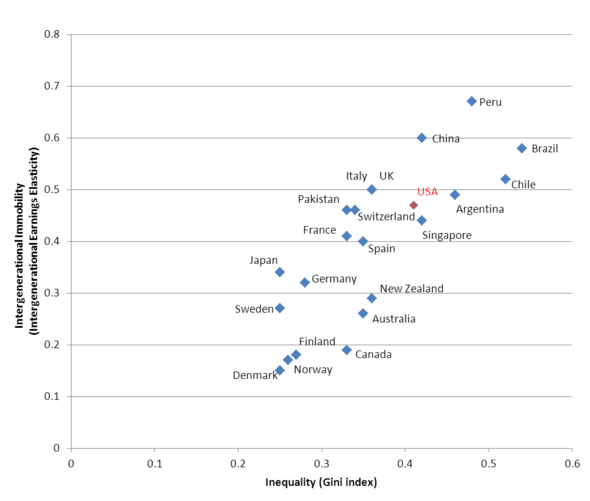
"More important, in any capitalist society most people are bound to be part of the middle and working classes; public policy should focus on raising their standard of living, instead of raising their chances of getting rich. What made the U.S. economy so remarkable for most of the twentieth century was the fact that, even if working people never moved into a different class, over time they saw their standard of living rise sharply. ... Raising living standards for ordinary workers is hard: you need to either get wages growing or talk about things that scare politicians, like “redistribution” and “taxes.” But making it easier for some Americans to move up the economic ladder is no great triumph if most can barely hold on."
It's a strong point, one which Paul Krugman then takes up and restates more snappily with,
"if you want a society in which everyone has a decent life, you need to construct a society in which everyone has a decent life — not a society in which everyone has a small but equal chance of living the lifestyle of the rich and famous. ... Since anyone could find himself or herself downwardly mobile, social mobility arguably actually strengthens the case for a strong safety net."Mobility isn't all it's cracked up to be. It has downs with it's ups. Unlike an overall higher standard of living.
The American way is a melting pot or at least a mixing bowl, not a sieve.
The American way is a melting pot or at least a mixing bowl, not a sieve.
We may preserve elements rather than fusing into a homogeneous mass, but we mix. It's how we come up with our best, by exchanging ideas and forging something new.
This isn't the first time folks have fought against the melting pot. But those who fight it are just as wrong now as they were before. We gain much from being a harmonious mixture of different ingredients that stand together. Baking soda is great in a cookie; not so good on its own.
--
See also Paul Brandeis Raushenbush's "'Sincerely Held Religious Beliefs' and the Fraying of America" regarding "discriminatory and deeply un-American" legislation in Arizona.
We may preserve elements rather than fusing into a homogeneous mass, but we mix. It's how we come up with our best, by exchanging ideas and forging something new.
This isn't the first time folks have fought against the melting pot. But those who fight it are just as wrong now as they were before. We gain much from being a harmonious mixture of different ingredients that stand together. Baking soda is great in a cookie; not so good on its own.
--
See also Paul Brandeis Raushenbush's "'Sincerely Held Religious Beliefs' and the Fraying of America" regarding "discriminatory and deeply un-American" legislation in Arizona.
Subscribe to:
Posts (Atom)