Some see low interest education loans as distorting the market for education and therefore bad, supposedly making the market less perfect, less efficient, less well-tuned.
Why focus on the narrow education loan segment alone as if it weren't entirely and necessarily interconnected with the needs it serves. What about business needs? The larger market ecosystem -- the economics of business and education -- involves a requirement for a supply of educated workers. Limiting the supply to only those who can pay their own way into education impedes business, a practical flaw in the greater job market. How would it be perfecting the greater job market to reduce the supply of educated workers to business when it is already insufficient?
This opposition to "distortion" on a narrow, inextricable segment of the greater system fails to qualify as an objective "good". It's an artificial and aesthetic goal rather than a practical, objective improvement of the greater economic system. The greater economic system for workforce education can relatively objectively be seen as functioning more perfectly when it yields a supply of qualified labor that's sufficient to foster business profits and yet not so excessive as to detract from employee prosperity. The current system falls short in supply of educated workforce.
Seeing loans as a distortion here is rather like seeing the spokes in a gear as a distortion from a perfect circle. Yes, those teeth on a gear distort its form from a perfect circle. But cut the teeth off the gear that drives the propulsion and a machine won't get very far. Education loans serve as teeth for the workforce capability gear. Remove the "distortion" from education loans and the wheels of modern business will slow towards a halt.
Sometimes getting rid of distortion would rob us of what we need most.
Showing posts with label education. Show all posts
Showing posts with label education. Show all posts
Wednesday, August 28, 2013

Tuesday, September 11, 2012
Returns on Education
A chart from The Economist, showing "A college education is good for your well-being and your wallet":


Thursday, March 8, 2012
Income and Education
"Figure A shows the percentage of people who have completed a college degree. It groups them into quartiles (groups of 25%) based on their performance in 8th grade mathematics and their SES. There are three test score groups—low score (kids scoring in the bottom quartile), middle score (kids scoring in the two middle quartiles), and high score (kids scoring in the top quartile). In each test score group (low, middle, and high) there are three bars shown, one for those in the bottom quartile in terms of SES (low income), one for those in the two middle quartiles in SES (middle income), and one for those in the top quartile (high income)."
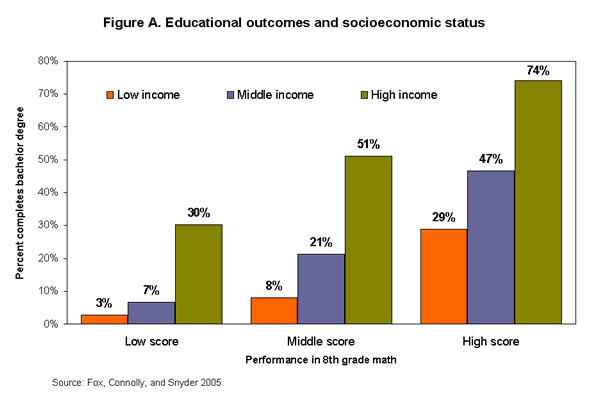
from "Low income hinders college attendance for even the highest achieving students"
Monday, February 13, 2012
Education Spending, the Prequel (pre-2005)
Gravity and Education Spending spoke to the federal education funding situation from 2005 and thereafter. Here's one that addresses the years before that by borrowing a chart from ed.gov. Note how little that gray federal segment is compared to the rest of the bars. And they wonder why fluctuations in federal education spending don't correlate with student performance. Maybe it could be the fact that federal education spending has generally been a small portion of the total.
 |
| from http://www2.ed.gov/about/overview/fed/10facts/edlite-chart.html#2 |
Gravity and Education Spending
There's a CATO Institute graph going around that paints a very distorted picture as if we had some sort of continuously skyrocketing federal spending on education. In truth, that's not the case at all. We saw a very large -- but very brief -- spike on account of the Great Recession. The CATO graph neglects to include the estimates for 2011 and 2012 spending that show it going back down.
Sometimes what went up comes back down. And that's without even adjusting for inflation.
The 2010 through 2012 figures are estimates. But CATO included the 2010 estimate, so why not the rest of the picture so that we could see it comes back down?
What happens if we adjust for inflation and population?

 |
| Data from http://www.gpoaccess.gov/usbudget/fy11/pdf/hist.pdf |
The 2010 through 2012 figures are estimates. But CATO included the 2010 estimate, so why not the rest of the picture so that we could see it comes back down?
What happens if we adjust for inflation and population?
Not only does the brief boost go away, but it looks like its going to go below 2005 levels.
Update: for a little pre-2005 context, see Education Spending, the Prequel (pre-2005).
Saturday, January 8, 2011
Improvements to Education Benefit for Veterans
On the Post-9/11 Veterans Educational Assistance Improvements Act of 2010, "“The young men and women in the Armed Forces provide an incredible service to our nation,” said Senator Akaka, a World War II veteran who attended college on the original GI Bill. “With the signing of this bill, young veterans will now have an easier time utilizing the education benefits they have earned. I applaud President Obama and my colleagues in Congress for enacting this important legislation.”"
from "President Obama signs Post-9/11 Veterans Educational Assistance Improvements Act into law"
from "President Obama signs Post-9/11 Veterans Educational Assistance Improvements Act into law"
Subscribe to:
Posts (Atom)