We know that in at least one state and possibly all of the key states, Republican voter suppression laws turned the 2016 Presidential election.
How much funding did the NRA put into these efforts? And how much of that came from Russia?
Thursday, July 19, 2018

Wednesday, July 18, 2018
Trump's Treason Summit
One has to wonder: what could move Republicans to oppose Trump if not his Treasonous attacks on America from a summit with Putin? What is backing the word of a foreign dictator whose interests oppose our own over the word of our whole US intelligence community if not "giving [enemies] aid and comfort within the United States or elsewhere"?

Sure, he's since read a statement -- or should we say script -- to walk back one small word of what he said. Not that his reading seemed sincere, but even if it had, consider how the original "would" fits much more with everything else he said before and after than the "wouldn't" that he claimed when reading his script.

Saturday, December 2, 2017
Wednesday, November 1, 2017
John Kelly and Robert E Lee
Of particular interest: the pattern.
Secretary Kelly praises traitorous, insurrection-leader Lee (who was never legally a general), implying that Lee wouldn't have opposed compromise.
But the slaver side -- Lee's side -- refused compromise. The abolitionists worked hard to avoid war, arguably far harder than they should have. The their efforts to compromise with slavers might be the greatest taint on the legacy of the abolitionists. In the end, Lee's side utterly rejected working with those who wanted progress, even if Lee's side would have gotten excessive concessions in the bargain.
Today, we can see this in the party whose members typically praise Lee, today's Republicans. Today's Democrats were so desperate to improve healthcare that -- failing to get Republicans to accept their ideal -- they settled for adopting a Republican plan (which became Romneycare and then the ACA / Obamacare) ... just to have some chance of finding a way to compromise and get some meager improvement. But the Republican party rejected compromise, even if that compromise was built upon accepting their designs, their approach.
It's no wonder they praise the Lee's of history. They are the inheritors of Lee's anti-compromise, anti-progress ways in all but name.
Secretary Kelly praises traitorous, insurrection-leader Lee (who was never legally a general), implying that Lee wouldn't have opposed compromise.
But the slaver side -- Lee's side -- refused compromise. The abolitionists worked hard to avoid war, arguably far harder than they should have. The their efforts to compromise with slavers might be the greatest taint on the legacy of the abolitionists. In the end, Lee's side utterly rejected working with those who wanted progress, even if Lee's side would have gotten excessive concessions in the bargain.
Today, we can see this in the party whose members typically praise Lee, today's Republicans. Today's Democrats were so desperate to improve healthcare that -- failing to get Republicans to accept their ideal -- they settled for adopting a Republican plan (which became Romneycare and then the ACA / Obamacare) ... just to have some chance of finding a way to compromise and get some meager improvement. But the Republican party rejected compromise, even if that compromise was built upon accepting their designs, their approach.
It's no wonder they praise the Lee's of history. They are the inheritors of Lee's anti-compromise, anti-progress ways in all but name.
Friday, September 15, 2017
The Latest WSJ Revelations on Flynn and Russian Involvement While On the NSC
"According to the [Wall Street] Journal, the ethics advisors on the National Security Council actually told him to remove himself from this project but quote the activity continued." - Rachel Maddow
See the rest in "New revelations deepen Flynn legal jeopardy".
See the rest in "New revelations deepen Flynn legal jeopardy".
Wednesday, August 9, 2017
Payroll Coasting
A picture of coasting:

What was the question we collectively were asking ourselves? Perhaps, "Hey, what would happen if -- before really fully recovering -- we stopped pushing the economy back towards health as soon as we pulled it out of actively crashing?"
If we aim a car up a very slight incline and get going pretty fast and don't hit the brakes, it'll keep going at a fairly steady pace for a while even after the driver's foot leaves the accelerator. Not forever. But for a while.
Realistically, the foot isn't all the way off the pedal. It's more like we've cut back on the gas after quickly getting up to speed on the on-ramp.
We're way below speed limit though. Was that the plan? Why did that seem like a good idea?

What was the question we collectively were asking ourselves? Perhaps, "Hey, what would happen if -- before really fully recovering -- we stopped pushing the economy back towards health as soon as we pulled it out of actively crashing?"
If we aim a car up a very slight incline and get going pretty fast and don't hit the brakes, it'll keep going at a fairly steady pace for a while even after the driver's foot leaves the accelerator. Not forever. But for a while.
Realistically, the foot isn't all the way off the pedal. It's more like we've cut back on the gas after quickly getting up to speed on the on-ramp.
We're way below speed limit though. Was that the plan? Why did that seem like a good idea?
Tuesday, July 25, 2017
How Necessities Have Eaten America's Personal Discretionary Spending Capacity

A Business Insider article tells us "How America's spending habits have changed since 1941".
Spending "habits"? How about how costs have changed?
Seriously, who really believes that Americans want to allot such large portions of our income to housing -- whether rent or mortgage -- and transportation? Let's not forget about debt service, largely for housing and for investing in education to get jobs. And how many wouldn't want to be able to spend more on clothing, food & dining, and personal care?
New headline: how necessities have eaten America's personal discretionary spending capacity.
Thursday, June 8, 2017

Thursday, March 9, 2017

Monday, February 20, 2017
What Drove the 2016 Election Results
Already, this is too easy to forget.
We've covered that Republican turnout was actually low. Not by much, but slightly below trend. Meanwhile Democratic turnout -- although not high enough to win the crucial red states -- was fairly good nationwide, if down somewhat from the previous peak. It just wasn't quite good enough in a few keys states. Why? Was there some winning over of voters on a policy issue? No, most folks who voted stuck to their usual party. So how did it happen? Largely, the voter data shows it hinged upon that just barely enough-to-swing-it previously Democratic-leaning voters didn't vote in 2016. While voter data alone can't tell us exactly what drove that swing, it shows that the question of the election was what kept just the critical number of voters in the key states from showing up.
Aside from rather successful Republican voter suppression efforts with voter ID laws, Matthew Yglesias performed a solid analysis of how the story rolled. In short, it was the emails. As Yglesias puts it, "Indeed, research from Gallup indicates that emails dominated what voters heard about Clinton all throughout the campaign."
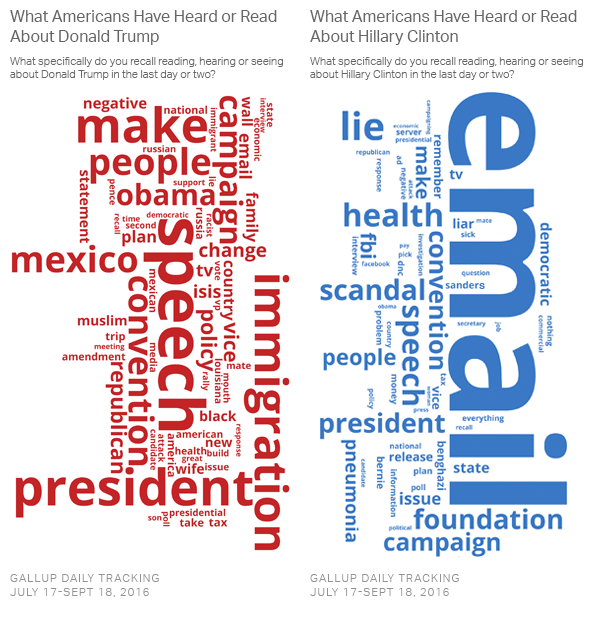
That's it. That's ultimately the issue on which the 45th Presidency turned. The choice of which email server to use. Not jobs. Not healthcare. Not taxes. Not immigration. It's the emails.
Yes, arguably, the Democrat's candidate might have been able to win despite the email issue had she been more charismatic, better able to inspire even more people to look at her carefully developed set of sensible policy approaches. That it was the emails does not defend the performance of the candidate who merely won the popular vote. While the campaign platform may have been solid and the campaign pitched those policies enough to earn a sizeable majority of the popular vote nationwide, the 2016 Clinton campaign failed to make it about all those thoroughly thought-out policies in enough states. Crucially, she failed to make it not be about the emails in key swing states.
But any "might have" doesn't change what it was about. Where the votes counted, it was about the emails. If there was anything the 2016 election can be said to be about: the overriding mandate from the electorate was, "do not use a private email server as a public servant".
Let's not forget that. No matter how tempting it might be to forget.
Meanwhile, if there's a lesson for future campaigns, it would seem to be this: pick a candidate far too charismatic to have their message drowned out by some flap about what server they used for their email.
We've covered that Republican turnout was actually low. Not by much, but slightly below trend. Meanwhile Democratic turnout -- although not high enough to win the crucial red states -- was fairly good nationwide, if down somewhat from the previous peak. It just wasn't quite good enough in a few keys states. Why? Was there some winning over of voters on a policy issue? No, most folks who voted stuck to their usual party. So how did it happen? Largely, the voter data shows it hinged upon that just barely enough-to-swing-it previously Democratic-leaning voters didn't vote in 2016. While voter data alone can't tell us exactly what drove that swing, it shows that the question of the election was what kept just the critical number of voters in the key states from showing up.
Aside from rather successful Republican voter suppression efforts with voter ID laws, Matthew Yglesias performed a solid analysis of how the story rolled. In short, it was the emails. As Yglesias puts it, "Indeed, research from Gallup indicates that emails dominated what voters heard about Clinton all throughout the campaign."
That's it. That's ultimately the issue on which the 45th Presidency turned. The choice of which email server to use. Not jobs. Not healthcare. Not taxes. Not immigration. It's the emails.
Yes, arguably, the Democrat's candidate might have been able to win despite the email issue had she been more charismatic, better able to inspire even more people to look at her carefully developed set of sensible policy approaches. That it was the emails does not defend the performance of the candidate who merely won the popular vote. While the campaign platform may have been solid and the campaign pitched those policies enough to earn a sizeable majority of the popular vote nationwide, the 2016 Clinton campaign failed to make it about all those thoroughly thought-out policies in enough states. Crucially, she failed to make it not be about the emails in key swing states.
But any "might have" doesn't change what it was about. Where the votes counted, it was about the emails. If there was anything the 2016 election can be said to be about: the overriding mandate from the electorate was, "do not use a private email server as a public servant".
Let's not forget that. No matter how tempting it might be to forget.
Meanwhile, if there's a lesson for future campaigns, it would seem to be this: pick a candidate far too charismatic to have their message drowned out by some flap about what server they used for their email.
Wednesday, February 8, 2017
Republican Senators Terrified of 1986 Letter
The letter that Republican Senators of the 115th Congress couldn't stand to hear read by Senator Warren follows. It happens to be a letter that Republicans of 30 years ago could stomach and found compelling. But in 2017, they can't stand to hear it.


Tuesday, February 7, 2017
The Conspiracy Theorist In Chief

The Washington Post reports that the 45th President appears to be getting many of his ideas in what's happening in the world from the InfoWars conspiracy theory site. Or rather, it should perhaps be said that they've joined others in noting this state of affairs, including CNN, NPR, and The New Yorker.
That crazy uncle or grandpa who rattles off conspiracy theories and makes family gatherings uncomfortable? There appears to be one sitting behind the desk in the Oval Office.
So much has already been horribly bungled by the Conspiracy Theorist In Chief.

It is, as Theodore Roosevelt said of then-President Wilson, "even more important to tell the truth, pleasant or unpleasant, about him than about anyone else."
And the truth is that it's time for Congress to begin impeachment hearings regarding the 45th President.
Sunday, January 29, 2017
Reagan On Religious Discrimination
"We must never remain silent in the face of bigotry. We must condemn those who seek to divide us. In all quarters and at all times, we must teach tolerance and denounce racism, anti-Semitism, and all ethnic or religious bigotry wherever they exist as unacceptable evils. We have no place for haters in America -- none, whatsoever."
-- President Ronald Reagan
-- President Ronald Reagan
Saturday, January 28, 2017
Week One for the 45th
One of the most important duties of any head of state obviously would be serving as the nation's chief diplomat.
If one were trying to go down in history as our worst President ever, it would be very challenging to get a faster start at it than by pissing off two of our three largest export markets before even making it through the first week on the job.
As individual countries go, our 2nd and 3rd largest export markets are Mexico and China. Together, they buy almost a quarter of our total exports.
Thanks to our current President's "diplomacy", our 3rd largest export market has found it necessary to move their nuclear missiles within striking distance of us ... ya' know, just in case. And the citizens of our 2nd largest export market have begun a large-ish boycott of American companies.
So it's been a stellar week for America, right?
Friday, January 27, 2017
A Reasonable Degree of Confidence

When we say that tariffs are a bad idea, it isn't for lack of real world experience. We've seen what happens with tariffs. There may not be clear certainty on what exactly would be the ideal economics policy mix for any point of time. That doesn't mean there's any lack of clarity that adopting tariffs would be the path of fools and/or fanatics. We know enough about economics to recognize the gaps in our knowledge; but also to know what's reasonably certain. And it is reasonably certain that proposing tariffs betrays an entirely simplistic failure to understand much about economics, one might call it having a grade-school understanding of economics. Not even up to the level of Econ 101, where a whole different set of simplistic misunderstandings thrive.
When climate scientists say that anthropogenic climate change is a thing. A real thing. In the really, real world. That it's happening. Do they have doubts? Sort of. They clearly have doubts about exactly where on the range of projections the actual course of temperatures will plot in future graphs of the past. But they have a high degree of certainty that it can reasonably be expected to be within a certain range. They understand the gaps in their knowledge, the variables that could cause various differences within the projected ranges. But they also know enough to know that the people who reject the whole set of ranges just don't know what they're talking about. To wit, that they're fools.
When those with experience like Madeleine Albright say that being anti-immigrant isn't consistent with the best interest of that nation, it's with an understanding of the challenges involved. But it's also from knowing that those who would coarsely implement a blanket closing of the door from an entire country don't have a good grasp of the known repercussions. Immigration experts may be all too aware of the gaps in their capacity to achieve perfection with immigration policies and screening methods, but they're also aware that simplistically just barring the door to all comers would -- quite clearly -- be far worse than accepting the imperfections of our best available procedures that keep the door open.
There's profound difference between being uncertain as to what's perfect and being less than certain as to what's clearly wrong. Wiser people are full of doubts as to what's perfect. But wiser people tend to be quite certain that the fools' plans are at least worse and often flat out entirely wrong. There's another term for having "alternative facts"; it's called being wrong (or outright lying, in the case of those who know better).
We need to stop letting that which is clearly wrong go as if it were merely a difference of opinion rather than a flat out failure to have sufficient grasp of the subject.
Even with recognition of what we do not know, we can be fairly certain of that.
Saturday, December 3, 2016
Digging into the State Story in the Rust Belt
We've already seen that on the national level, the story of the 2016 Presidential election was simply that the rough trend continued, with turnout approaching the norm.
As more analysis on the state specific level comes in, particularly with regard to the states that defied conventional wisdom, we can now get a more data-backed analysis of what happened there:
-- from The Myth of the Rust Belt Revolt
The supposed flight of working class voters to Trump just didn't fit, as some had already guessed just from looking at the overview, particularly in income bracket totals. Instead, it was that people who'd previously shown a leaning towards Democrat decided for whatever reason that they weren't going to vote for a front-runner this year.
And since this change wasn't well reflected in the general trend of polls leading up, we can figure a good bit of it was a last minute change. Exit polls don't tell us much about the specific reasons why there, so it's hard to get more than speculation on the full details spurring such a turn.
Perhaps that last minute flurry of attacks on the Democratic candidate among "fake news" outfits?
And just how much of it was because of Comey's unconventionally timed interference?
As more analysis on the state specific level comes in, particularly with regard to the states that defied conventional wisdom, we can now get a more data-backed analysis of what happened there:
"4. The real story—the one the pundits missed—is that voters who fled the Democrats in the Rust Belt 5 were twice as likely either to vote for a third party or to stay at home than to embrace Trump."
-- from The Myth of the Rust Belt Revolt
The supposed flight of working class voters to Trump just didn't fit, as some had already guessed just from looking at the overview, particularly in income bracket totals. Instead, it was that people who'd previously shown a leaning towards Democrat decided for whatever reason that they weren't going to vote for a front-runner this year.
And since this change wasn't well reflected in the general trend of polls leading up, we can figure a good bit of it was a last minute change. Exit polls don't tell us much about the specific reasons why there, so it's hard to get more than speculation on the full details spurring such a turn.
Perhaps that last minute flurry of attacks on the Democratic candidate among "fake news" outfits?
And just how much of it was because of Comey's unconventionally timed interference?
Tuesday, November 29, 2016
Taxes Are Pro Growth
Will we ever get people to stop pretending lower and lower taxes are somehow more and more "pro growth"?
Infrastructure spending is pro growth.
R&D spending is pro growth.
Educating the labor pool is pro growth.
Setting safety standards is pro growth.
Grants to startups are pro growth.
Safety nets mitigating risks are pro growth.
Redistribution so all can spend is pro growth.
All of these things tend to come from taxes. Maintaining at least moderate taxes is pro growth. Increasing taxes on those of us with more tends to be pro growth.
Lowering taxes is anti-growth, unless it's strictly done only for those who already lack a surplus.
Monday, November 28, 2016
Broad Stroke Story of The Election: National Versus State

In broad strokes, the national-level story of the United States 2016 Presidential election could be described as that the rough trend continued.
| D/VAP | R/VAP | Avg/VAP | |
| 1996 | 0.2409 | 0.1992 | 0.2200 |
| 2000 | 0.2431 | 0.2405 | 0.2418 |
| 2004 | 0.2689 | 0.2826 | 0.2757 |
| 2008 | 0.3022 | 0.2607 | 0.2815 |
| 2012 | 0.2802 | 0.2590 | 0.2696 |
| 2016 | 0.2575 | 0.2487 | 0.2531 |
There was a swing up between the mid 90s and the mid 00s. The Democratic and Republican percentages of the voting age population (VAP) both increased in 2000 and 2004, with a much bigger Republican increase in 2000.
Then there was a transition in 2008. That year, the Democrats had a much bigger increase equivalent to the Republican jump of 2000. Meanwhile, the Republican turnout began sliding down.
And now we're in a swing down in the 10s. The Democratic and Republican percentages of the voting age population both decreased in 2012 and 2016.
Where will we go from here? For both parties, the percentage of the VAP in 2016 was still up from what either party saw in 1996 and 2000. Considering the past two decades on average, we can't really say there was low turnout in 2016; just not quite as high as the peaks. Both candidates this year got a higher percentage of the potential vote -- more support -- than even the winning candidates from 16 and 20 years ago. We'd have to go back to 1984 to find a higher percentage of the VAP turning up for the two major parties; and that was the only higher year between 1980 and 2000. Based on the trend of the last 10 elections, we're likely only approaching the valley and barring some particular phenomenon drawing more people out to vote we'll likely see yet another decline in overall turnout next Presidential election.

If there's one thing we can say from the overall national trend, it's that the narrative of unenthused voters doesn't really fit. We've heard claims that voters were particularly disinterested in these candidates. Yet what drop there was this year was only in keeping with the direction of the past few elections. The turnout / VAP in 2016 remained over the average for the last 10 elections.
There also quite clearly was no national surge whatsoever toward the Republican party. On the contrary, the Republican specific turnout was yet again down slightly, just like in the previous election. In fact, this year's Republican turnout brought it low enough at 24.87% to be below the 25.47% average Republican turnout for the last 10 elections.
Democratic turnout also was only down this year by about the same degree it was down the previous Presidential election. And that was only returning it towards the rough trend, smoothing out from previous big gains. The 2016 Democratic turnout of 25.75% remained slightly above the 24.92% they've seen for the last 10 elections.
By and large, the nation continued a return towards trend. The Republican party dipped slightly below their average; and the Democratic party remaining slightly above. There may have been changes in the character of each party's support, such as the widely reported gains among the less educated for Republicans and among the more educated for Democrats. But these qualitative fluctuations did not budge the totals from the previous quantitative heading nationally.
If there's a major story specific to this 2016 Presidential election that differs from the typical trend of the previous years, it would have to be at the state-by-state level. It isn't just that a few states decided the election in the electoral college; it's also that what happened in those particular states and the states that went the other way from them would together have to be the entire story of how this election might differ from the norm in voting.
* Popular vote totals used for the above analysis were derived from Dave Leip's Atlas of U.S. Presidential Elections as of 11/28/2016.
Broad Stroke Story of The Election: National Versus State
In broad strokes, the national-level story of the United States 2016 Presidential election could be described as that the rough trend continued.
| D/VAP | R/VAP | Avg/VAP | |
| 1996 | 0.2409 | 0.1992 | 0.2200 |
| 2000 | 0.2431 | 0.2405 | 0.2418 |
| 2004 | 0.2689 | 0.2826 | 0.2757 |
| 2008 | 0.3022 | 0.2607 | 0.2815 |
| 2012 | 0.2802 | 0.2590 | 0.2696 |
| 2016 | 0.2575 | 0.2487 | 0.2531 |
There was a swing up between the mid 90s and the mid 00s. The Democratic and Republican percentages of the voting age population (VAP) both increased in 2000 and 2004, with a much bigger Republican increase in 2000.
Then there was a transition in 2008. That year, the Democrats had a much bigger increase equivalent to the Republican jump of 2000. Meanwhile, the Republican turnout began sliding down.
And now we're in a swing down in the 10s. The Democratic and Republican percentages of the voting age population both decreased in 2012 and 2016.
Where will we go from here? For both parties, the percentage of the VAP in 2016 was still up from what either party saw in 1996 and 2000. Considering the past two decades on average, we can't really say there was low turnout in 2016; just not quite as high as the peaks. Both candidates this year got a higher percentage of the potential vote -- more support -- than even the winning candidates from 16 and 20 years ago. We'd have to go back to 1984 to find a higher percentage of the VAP turning up for the two major parties; and that was the only higher year between 1980 and 2000. Based on the trend of the last 10 elections, we're likely approaching the valley if not having bottomed out for the current downswing.
If there's one thing we can say from the overall national trend, it's that the narrative of unenthused voters doesn't really fit. We've heard claims that voters were particularly disinterested in these candidates. Yet what drop there was this year was only in keeping with the direction of the past few elections. The turnout / VAP in 2016 remained over the average for the last 10 elections.
There also quite clearly was no national surge whatsoever toward the Republican party. On the contrary, the Republican specific turnout was yet again down slightly, just like in the previous election. In fact, this year's Republican turnout brought it low enough at 24.87% to be below the 25.47% average Republican turnout for the last 10 elections.
Democratic turnout also was only down this year by about the same degree it was down the previous Presidential election. And that was only returning it towards the rough trend, smoothing out from previous big gains. The 2016 Democratic turnout of 25.75% remained slightly above the 24.92% they've seen for the last 10 elections.
By and large, the nation continued a return towards trend with the Republican party dipping slightly below their average and the Democratic party remaining slightly above. There may have been changes in the character of each party's support, such as the widely reported gains among the less educated for Republicans and among the more educated for Democrats. But these qualitative fluctuations did not budge the totals from the previous quantitative heading nationally.
If there's a major story specific to this 2016 Presidential election that differs from the typical trend of the previous years, it would have to be at the state-by-state level. It isn't just that a few states decided the election in the electoral college; it's also that what happened in those particular states and the states that went the other way from them would together have to be the entire story of how this election might differ from the norm in voting.
* Popular vote totals used for the above analysis were derived from Dave Leip's Atlas of U.S. Presidential Elections as of 11/28/2016.
Wednesday, November 16, 2016
Eichenwald on How

Awash in false conspiracy theories, protest voters and angry non-voters put Trump in the White House.
newsweek.com|By Kurt Eichenwald
Subscribe to:
Posts (Atom)